Who is supposed to draft your agreements? You are!!!
Published
We’ve already seen what happens when you leave drafting your agreements entirely to an uninterested legal team.
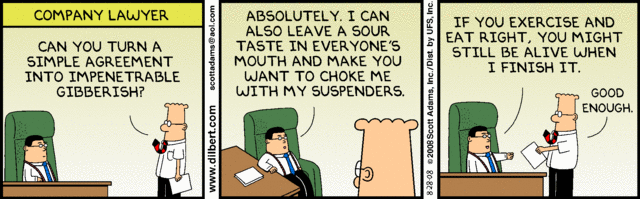
Yet people still have their lawyers draft up an agreement, which more than likely for most contracts really is a paralegal filling out a word template. There are lots of myths surrounding agreements that I wrote about earlier in It wont hold up in Court.
I can’t stress enough that an agreement is not between lawyers, it’s between it’s parties. You as the entrepreneur and the other party, whether it is your users in a User Agreement, your client in a consulting agreement or an investor in a term sheet.
Yes for many of these you need to bring lawyers in. In particular high value risky agreements such as Term Sheets you need lawyers to help you out. That does not remove your responsibility however to understand the core of the agreement.
The mysterious Uncle Saul who is now one of my favorite bloggers says in his great post Roping in the Legal Eagles :
As the businessperson with the most intimate knowledge of a particular deal, you should draft as much of the “business-oriented text” of your contracts as possible. At the very least, you or the appropriate member of your team should document the primary deal points in bullet-point form. The more specifically you document the business terms, the fewer iterations will be required to finalize the agreement. Even a highly attentive, business-oriented lawyer cannot put himself in your shoes. They do not work at your company, so there is no way they will have your insights. Thus, the more work you do upfront to document the business issues, the less you will ultimately be charged and the more closely the agreement will reflect the spirit of your verbal negotiations.
Your Lawyers do NOT and can NOT understand every aspect of your business. Only you and your team have that knowledge. Uncle Saul continues:
There is no magic language which makes an agreement legally binding; in fact, in most cases, the simpler the text, the better. Many a binding contract has been written on the equivalent of the back of a napkin. Once you draft the straightforward text, sans the legal mumbo-jumbo, ask your lawyer to review the text to ensure your layman descriptions do not result in an unintended interpretation. As noted in Tom and Huck, plans and agreements written in plain language reduce confusion and benefit all parties. If you select the right lawyer, he will not load up your text with gratuitous legal jargon (leave that job to the BDC’s legal squad).
Go read the rest of Roping in the Legal Eagles for more tips on how to create and deal with a good legal team.
I guess my best advise here is to remember that it is your job as an entrepreneur to take risks. It is the lawyers job to avoid risk. Don’t let the lawyer talk you out of risks worth taking, have him educate you so you can make the decision if the risk is worth taking.