Logo Walls, or Faking It Till You Make It in Crypto and Stablecoins
Published
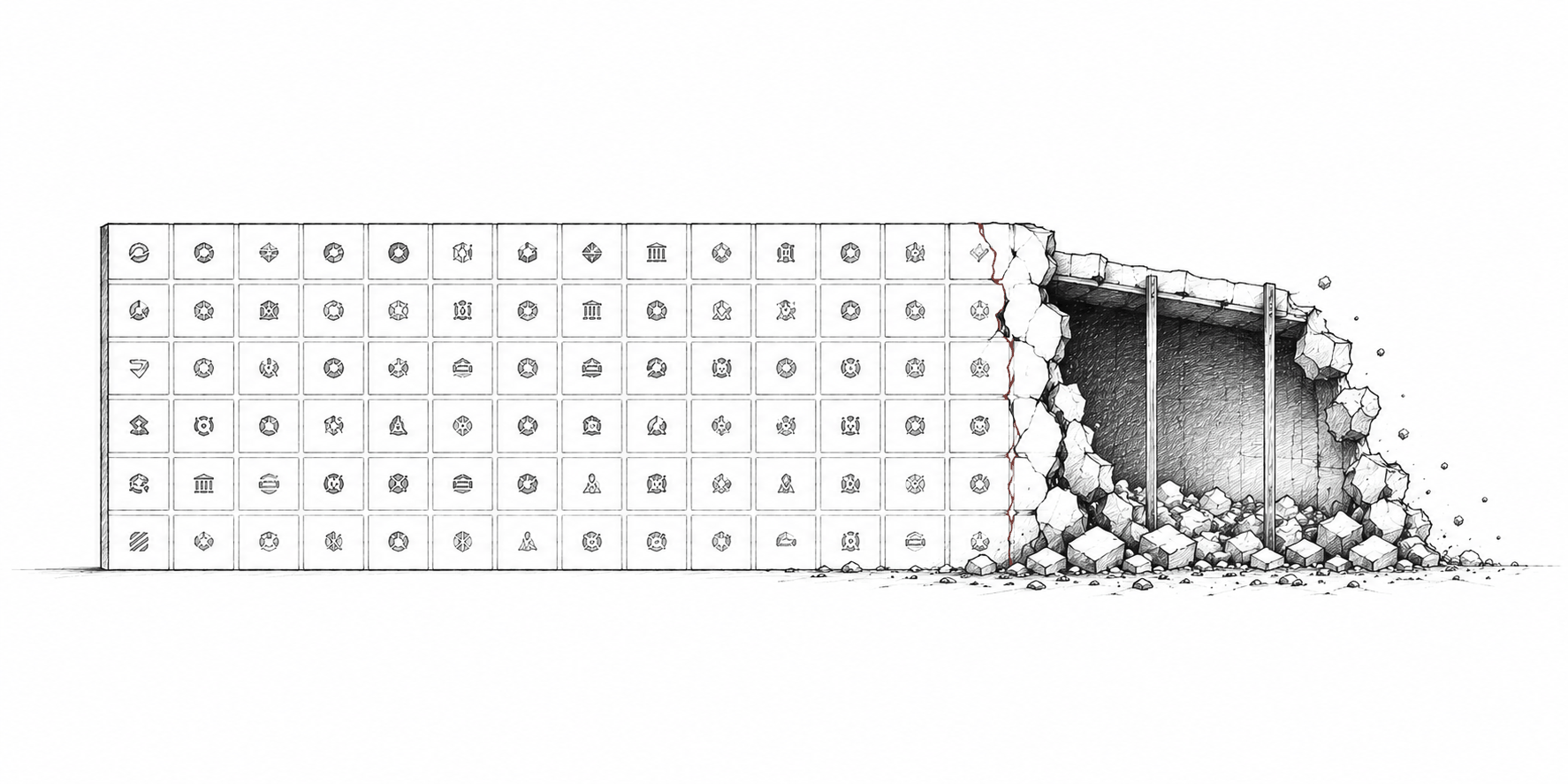
This week a new dollar stablecoin launched with a wall of more than 140 partner logos, and by the next morning the wall was falling off. Some of the biggest names on it, household electronics and banking giants, turned around and said they’d made no such commitment. One of them put it about as flatly as you can: there had been no official consultations, and they didn’t even know what role they were supposed to play. Then people started checking other names on the list, and found some of them had never signed anything either.
You probably already know exactly which launch I’m talking about. That’s rather the point, so I’m not going to name them.
Because it would be easy to just dunk, and that’s not the interesting part. The interesting part is that this used to work, and now it doesn’t. For us old timers in crypto, the logo wall is not a scandal. It’s a rite of passage. What changed is the market underneath it.
Why every network starts by faking it a little
Let’s be honest about the incentive, because it’s real. Every network has a cold start problem. Nobody wants to be your first partner, because your first partner joins a network of one. So you need to signal momentum before you actually have it. A wall of logos is the cheapest way to say “this is happening, get on board before you’re late.”
And in the early days of any category, that’s a rational, almost forgivable move. When nothing is real yet, nobody pays a price for a little theater. The whole room is doing it. There’s no live money to lose, no production integration to break, no regulator asking who’s on the hook. The logo wall is just a promise about the future, and everyone in the room knows it’s a promise.
So no, the sin isn’t ambition. The sin is claiming a committed relationship that doesn’t exist and hoping nobody calls the company to check.
I watched this happen up close
In the summer of 2020 we got invited into the FATF Virtual Asset Contact Group, the VACG. Notabene was tiny. We hadn’t even graduated from YC yet. And around the table were most of the competing Travel Rule protocols from huge crypto exchanges and commercial solutions of the day, most of them presenting slides with big walls of logos.
Two things jumped out at me, and I’ve never forgotten them.
The first: the same companies showed up on everybody’s wall. You could sit through three presentations from three rival protocols and see the same exchange claimed as a “partner” by all three. That exchange had, at most, taken a few calls.
The second: a few of the presenters were honest about it. They put a tiny footnote under the wall saying, in effect, “these are companies that joined our weekly Zoom workshop.” That footnote is the whole story. It means some people knew exactly where the line was and chose to stay on the right side of it. Which makes the ones who left off the footnote look a lot worse.
We didn’t build a wall. Partly we were too young to have one. But honestly we also felt it was disingenuous, and we were too naive to pretend otherwise. I’m not going to claim that was some brilliant strategic call at the time. It just felt wrong to put a company’s logo on our slide when all we’d done was get them on a Zoom.
What a logo costs today
Now look at what it takes to earn a single logo on the Notabene wall in 2026.
Every one of those customers put us through rigorous security review, external audits, contractual negotiation, and long procurement cycles. We comply with DORA in the EU on behalf of our customers. We comply with the MAS outsourcing guidelines in Singapore. We take GDPR, and the millions of local variations of it, seriously enough that we make genuinely hard architectural decisions to solve the substance and the spirit of the rule, not just to check the regulatory box the way some do.
That’s what sits behind one logo. Not interest. Not a Zoom call. Accountability.
And this is the reframe I’d push on anyone reading a shiny new logo wall: a logo is not a claim of interest, it’s a claim of accountability. Behind every real one there’s a signed contract, a named party on the hook for indemnity and liability, and a regulatory outsourcing obligation somebody’s compliance team fought over for months.
So when a brand-new network shows up with 140 logos in week one, I don’t feel FOMO. I ask boring questions. Do they have DORA compliance? Who carries the indemnity? Who’s liable when something breaks? A real financial institution will not put its name next to yours until it has answers, and it is not just banks that are this careful. The good, well-run, crypto-native exchanges are every bit as thorough on contracts and compliance as any bank. A wall of 140 logos with nobody accountable behind any of them isn’t a sign of scale. It’s a warning sign.
The reckoning always comes at volume
I keep watching the same movie. A network launches loud, with the wall, the coalition, the press. Then real volume shows up as the test, and it turns out the wall was holding up nothing.
We’ve watched a wave of stablecoin payment networks do exactly this over the last couple of years. Big alliance announcements, impressive rosters, a lot of noise. And then you go looking for actual transactions moving through them and there’s almost nothing there. Announcing a network and running a network are completely different sports.
I can be concrete about our own side of it. Since that FATF meeting in 2020, Notabene has processed more than $2.5 trillion in real transactions. Most of the protocols that sat in that room with the big walls of logos have processed, as far as I can tell, exactly zero. Same room, same starting line, in some cases the same logos. And most of them had far bigger names and far more important backers than a four-month-old Notabene did. Wildly different outcomes the moment it came time to move money.
Volume doesn’t care about your slides.
So why does it stop working?
The tactic didn’t get more dishonest. The stakes did. In 2020, Travel Rule was a slide and stablecoins were a trading toy, so betting on the wrong protocol cost you nothing. Today this is live financial infrastructure, with real settlement and real regulators. The moment picking the wrong network carries a real downside, people stop trusting the wall and start calling the names on it.
Here’s the part I’m still chewing on, so take it as a working theory rather than a law: every category has a window where faking it works, and the window closes the day the money gets real. Miss that turn and the exact move that bootstrapped you is the move that exposes you.
How to read a logo wall
I don’t really want to make this a lecture for the people launching these networks. They know what they’re doing. This is for the rest of us, the people these announcements are actually aimed at: the partners, the customers, the investors, the journalists who see the wall and feel the pull.
When you see it, ask the boring questions. Which of these are signed commercial relationships, and which are companies that took a call? Who is actually accountable behind each logo, on the hook for liability, indemnity, and the regulatory obligations a real integration carries? And the simplest one of all: how much volume has actually gone through this network? Pick up the phone and call two names on the wall. It’s remarkable how rarely anyone does, and how fast the wall comes down when they do.
And here’s the thing that should make you more skeptical, not less. The strongest players don’t need the wall. Take the launch everyone is talking about this week. That’s a serious, well-resourced team. They almost certainly would have generated just as much excitement launching with the right 20 real participants. Or even 10. The fact that a capable player reached for 140 names it couldn’t fully stand behind tells you how distorted the incentives around these launches have become. When you see a wall that big, the size itself is the warning sign, not the selling point.
Faking it till you make it was always a bet that you’d make it before anyone checked. In a serious market, people check. So check.