Agentic payments have a culture problem
Published
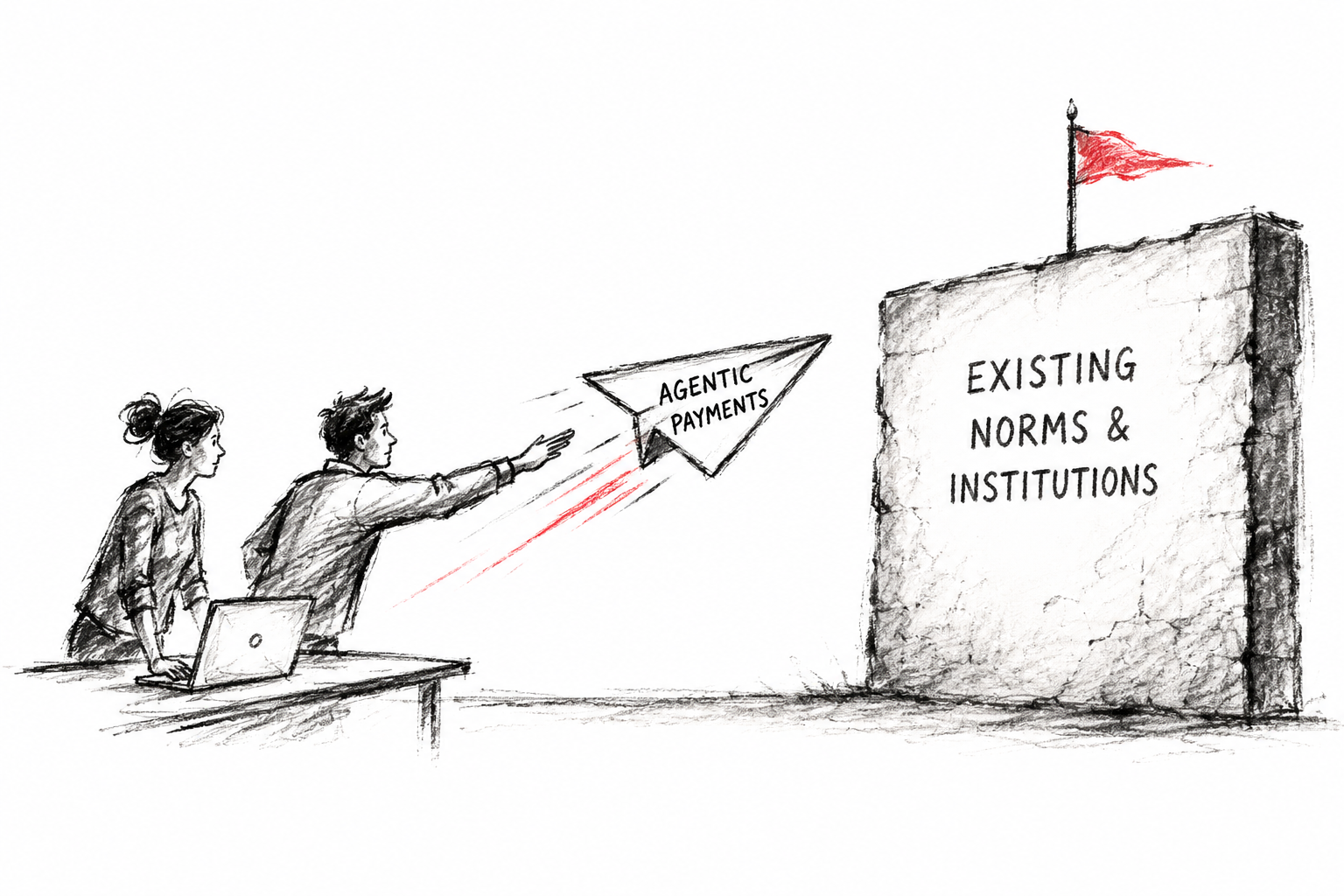
A lot of money is being thrown at agentic payments right now. In many cases it is reminiscent of a lot of the hype and excitement in the early days of crypto. I do believe that the real benefit of agentic payments is how it could potentially lower the transaction costs significantly for businesses. Not the fees that are paid, but the internal business-level transaction costs for both sides of the transaction. Unfortunately this is also where I think we may be hitting a stumbling block, the culture and norms around businesses that themselves were created to optimize transaction costs over the years.
In my last piece I argued that we keep letting a borrowed word do our thinking for us. This is the more expensive version of the same disease: we let a transaction cost keep shaping how we do business for years after the cost itself has gone. Almost none of the hard part here is the technology. The technology is nearly solved. The hard part is that fifteen years of business habits hardened around those costs, and culture does not notice when the cost that created it disappears.
I care about this because at Notabene I get to watch both sides of the gap at once. We sell to banks and fintechs, so I live inside the entrenched-culture world of annual contracts and purchase orders. We also watch trillions of dollars in stablecoin value settle across our network every year, which is exactly the technology that makes those contracts unnecessary. The economics have already flipped. The culture has not. That gap is the whole subject of this post.
The opportunity is genuinely big
Let me start with why this matters, because the obstacle only lands if you see the prize.
x402 takes a dusty corner of the web and finally wires it up. The HTTP response code 402, “Payment Required,” has sat in the spec marked reserved for future use since the early 1990s. x402 turns it on. A server can answer a request with “402, that will be a tenth of a cent,” your client pays in a stablecoin, and the request goes through. No account, no card on file, no invoice, no sales call. MPP, the merchant-payment-protocol layer growing up alongside it, does the same job for richer commerce flows where there is a real cart, a merchant, and an agent doing the buying.
Strip away the novelty and here is what they do: they crush the cost of moving a single tiny payment from “thirty cents and a card network” to “a fraction of a cent in a few seconds.”
But the cheap payment is not the prize. It is the key to the prize. The real saving is the internal cost of the transaction itself, on both sides, and that cost was never mainly the fee. It is the human apparatus wrapped around every deal: on the buyer’s side the procurement, the security review, the purchase order and the accounts-payable run; on the seller’s side the sales motion, the invoicing and the revenue-recognition schedule. Make the payment a fraction of a cent and let an AI agent do the searching, negotiating, and integrating that people used to do by hand, and the whole apparatus that exists to avoid doing that work over and over can simply come off. Both sides get lighter at the same time:
- The seller’s back office. Revenue is recognized as it is earned, per call, with no invoice, no collections, no rev-rec schedule someone made up.
- The buyer’s front office. Procurement collapses, because there is nothing to procure. An agent that needs a thing pays a tenth of a cent for it and moves on. No PO, no master agreement, no security questionnaire, no renewal.
If you are building software for AI agents, this is close to the ideal model: your customer is a program, it pays you for exactly what it consumes, and the whole sales-and-billing apparatus that humans needed simply is not there.
And notice the second move hiding inside the first. The same agentic processes that can pay per call can also do the back-office work itself. Finance, procurement, reconciliation, the internal transaction costs the annual contract existed to batch, are exactly the repetitive, rules-bound work an agent is good at. So even where the contract survives, agents can hollow out the costs that justified it. An agent that negotiates, authorizes, settles, and reconciles a payment end to end is dismantling the very apparatus the batch was built to amortize. This is a big part of what we are focused on at Notabene Flow, taking the manual finance and compliance work out of moving money between businesses, so the transaction cost falls whether or not anyone changes how they like to be billed.
So why isn’t everyone switching tomorrow?
The way we sell software is a transaction-cost hack in disguise
To see why the culture is so sticky, you have to see where it came from, and for that you need Ronald Coase.
Coase asked in 1937 why firms exist at all. If markets are so efficient, why isn’t every task just a contract between freelancers? His answer: using the market is not free. Every transaction has a cost: searching, negotiating, contracting, monitoring, enforcing, booking, and somewhere down the list, actually paying. Paying is only one item, and usually the smallest. We organize business to dodge the whole list. Once you have that lens you cannot unsee it: an enormous amount of how business is run is transaction-cost optimization wearing a disguise. It does not look like a hack to avoid a fee. It looks like “how things are done.”
The annual SaaS contract is the cleanest example I know. Walk a single $12,000-a-year deal through its real transactions: an MSA to redline, a security review, a procurement process and a purchase order, an invoice, an approval chain in accounts payable, a wire, a revenue-recognition schedule, and then a renewal negotiation eleven months later so the whole thing happens again. None of that is about the software. It is all there to amortize the friction of doing business across a year into one big, expensive, once-a-year event.
And the reason we never billed per use was only partly the payment. A thirty-cent card charge genuinely cannot collect a tenth of a cent, so per-use micro-billing was flatly impossible. But the fee was always the smaller half. The bigger cost was everything else in that list: the redlining, the security review, the purchase order, the approval chain, the rev-rec schedule. Doing all of that once a year was the only way to make the human cost of the transaction bearable. So we batched, against the fees and the paperwork together, and batching was the correct answer to the transaction costs of 2010. The annual contract is a beautifully engineered solution to a problem we no longer have.
x402 and MPP remove that problem. Which means the annual contract now outlives its own reason: the cost that justified it has collapsed, but the entire structure built around it has not. And that is the thing about a business habit. The reason for it can die quietly while the habit rolls on for years, because nobody ever tells the habit its reason is gone.
Why the habit refuses to die
This is where the uphill battle actually lives, and it is the part most people building on these rails get wrong. They assume that because the technology makes the annual contract unnecessary, the contract will fall away on its own. It will not, for one simple reason:
When technology removes the original reason for an optimization, the optimization does not die, because by then it is doing other jobs.
Over fifteen years the annual contract quietly accreted three secondary functions, and these are what keep it alive long after its transaction-cost rationale is gone:
- Certainty. A signed annual contract is a budget. The buyer’s CFO knows exactly what this line costs for the next twelve months. That predictability is not friction, it is a feature people pay a premium for. The job the annual contract is really hired to do, in Clayton Christensen’s sense, is “let me plan, and don’t make me look bad to finance.” It was never mainly about saving on billing.
- Liquidity. The seller gets a year of cash on day one. That lump funds the company. Metered revenue only dribbles in.
- Commitment. A year-long contract is lock-in. It lowers churn, and ARR built from annual contracts is what the entire venture-funding and valuation machine is wired to reward.
So the metered model that is strictly more efficient in transaction-cost terms can be a worse product, because it strips out the certainty, liquidity, and commitment people were buying along with the software.
| Annual prepay contract | Agentic / x402 | |
|---|---|---|
| Per-transaction cost | high, so you batch | near zero, so you don’t have to |
| Who holds the float | the seller (paid up front) | nobody (settles continuously) |
| Revenue when customer leaves | already collected | stops the moment usage stops |
| Skin in the game | weak (paid whether used or not) | strong (earn only on real use) |
| Budget certainty for the buyer | high (a fixed line item) | low (the bill moves with usage) |
| Antifragile to growth? | no, fragile to churn at renewal | yes, more usage is more revenue |
Look at that honestly and there is no single “efficient.” The metered, agentic model is antifragile to volume and aligns everyone’s skin in the game, which I love. But it is fragile to churn, and it shoves all the variance onto the buyer, who frequently does not want it. The people defending the old way are not being stupid. They are protecting real value. That is exactly why the battle is uphill and not flat. You are not fighting mere inertia. You are fighting genuine residual value that has fused with habit and identity until nobody can tell which is which.
The engineer’s conceit, and why it loses
The lazy version of this argument is the one I have to warn against hardest, because I have made it myself and lost real money on it: we technologists know the efficient way, and the culture is just in the way.
Years ago I built an e-signature company, Agree2, around the same time as DocuSign. I was right on the law and right on the technology: a contract does not need a handwritten-looking scribble, it needs a provable audit trail and genuine agreement. So I stripped the scribble out as pointless theater. DocuSign kept it, the fake cursive squiggle laid on top of the PDF, completely vestigial, and they won. Because the people sending contracts are not lawyers, and the squiggle is how they trust the thing. I optimized away the very feature doing the real job.
The annual contract has a lot of squiggle in it. Some of the procurement ritual is pure waste that agentic payments should delete tomorrow. But some of it is the CFO sleeping at night. Before you tear the fence down, the old rule applies: know why it was put up. Strip out the certainty along with the friction and you have built something more efficient and less wanted, which is precisely how a technically superior payment model loses to the incumbent who kept the squiggle.
The culture even rebuilds it on purpose
If you still think this is just cost and not culture, look at cloud computing, the one place metered billing already won.
AWS was the great victory of pay-as-you-go. Per-second billing, no contract, settle what you use. The transaction-cost optimization was beaten on its home turf. And what did large enterprises do once they had it? They demanded Reserved Instances, Savings Plans, and committed-spend agreements. They voluntarily bolted an annual prepaid commitment back on top of a perfectly good metered rail. Not because the metering was broken, but because finance wanted the certainty and lower costs and the vendor wanted the locked-in liquidity. The annual commitment grew back, by popular demand, on the most usage-based product ever built.
That is the tell, and it should sober up anyone betting on agentic payments. The annual commitment is not only a leftover from a dead cost. It is also a living thing people keep choosing. Which means x402 and MPP will not win by walking into an enterprise and announcing that the annual contract is obsolete. They will lose that fight, in that room, every time. The CFO is the home team there, and the CFO is partly right.
Your own investors want the annual contract too
Here is the part that traps the people actually building this, and it is the one I underrated longest, because the pressure does not come from the customer at all. It comes from your own cap table.
Venture math runs on ARR. A VC pricing your company is putting a multiple on annual recurring revenue, and in that worldview not all revenue is equal. A signed annual contract is “high quality” recurring revenue you can underwrite a Series A on. The exact same dollars arriving as a metered stream of micropayments read as usage: lumpy, churny, hard to forecast. Same money, lower multiple, because the funding machine was built to reward the contract, not the cash.
And there is a real reason under the prejudice, not just fashion. Metered billing is a wonderful model once you have already proven not just product-market fit but scalable product-market fit into a decent-sized market. Usage-based pricing only compounds if usage reliably grows and the TAM is big enough for that compounding to mean something. Before you have shown that, a metered line on a pitch deck is hard to tell apart from a science project. A handful of customers who signed annual or monthly contracts is the legible proof that someone will commit real budget to you, and that proof is frequently what it takes to raise the round that keeps the company alive long enough to build the metered future at all.
So the founder who most wants the pure usage-based, agent-native model gets pushed back toward annual contracts by the very people funding the future. The customer’s CFO defends the contract from one side of the table, and your own board defends it from the other. That is what “entrenched culture” actually means here. It is not one stubborn buyer. It is the whole system, demand side and supply side, wired to reward the old shape, while you sit in the middle trying to sell a fraction of a cent.
So how does it win? Against non-consumption
This is the Christensen move the whole essay has been walking toward, and it is the answer to the uphill battle.
You do not disrupt an incumbent by attacking it where it is strongest. You compete against non-consumption: all the transactions that do not happen today because arranging them would cost more than they are worth. That is where a “good enough,” radically cheaper option grows up unopposed, because the incumbent literally cannot serve that market and does not even want to.
And the non-consumption here is enormous, because it is most of what software could sell and doesn’t:
- One agent paying another agent a tenth of a cent for a single inference, a single lookup, a single tool call. There is no universe where you wrap an MSA and a purchase order around that. It happens at near-zero transaction cost or it never happens at all.
- The API you would gladly try for the one query you have today, except the smallest plan is $99 a month with a card and a commitment, so you just don’t.
- A single article, dataset, or piece of content nobody will ever subscribe to, but plenty of people, and plenty of agents, would happily pay a cent to read once.
- Every micro-service and capability too small to sell with a sales motion, and so currently unsold.
None of those are sitting inside someone’s annual contract waiting to be converted. They do not exist yet. That is the point. Agentic payments do not have to pry the enterprise deal loose. They get to mint a whole category of commerce the annual-invoice machine was structurally incapable of serving, because you cannot run a sales process around a fraction of a cent.
And this is not theoretical. Look at where x402 is actually getting traction today and it is almost all here: content sold by the article and APIs sold by the call, bought by agents, with no contract anywhere in sight. That is not a coincidence. It is the one place the old model could never reach, so there is no incumbent and no culture in the way.
That is the beachhead. Win there first, on transactions nobody was ever going to batch. Get genuinely good. Then, with real volume and a real track record, the model can start climbing toward the deals that today live on annual paper. Trying to start at the top, against the entrenched culture, is how you spend a decade losing.
How long will this take? Longer than the math says
This is the part I am least finished with. The economics flipped roughly the moment stablecoins made a sub-cent payment profitable. The culture will take years longer, because culture always lags the cost that created it.
We have run this movie before. I once wrote a post called Burn your checkbook, where I called paper checks “ancient pre-industrial-age relics.” Every economic reason to write a check died decades ago. The US still writes billions of them, purely on habit, installed base, and “this is how we pay our vendors.” The transaction cost that justified the check is long gone. The check is not, because nobody updated the culture when the cost changed. Agentic payments are walking straight into that same kind of stubborn habit, except this time it is the entire enterprise procurement and billing apparatus, which is a much bigger thing to move than a checkbook.
So the obstacle and the opportunity are the same fact seen from two sides: a transaction cost that has finally collapsed, and a culture that has not yet noticed. The opportunity is real and enormous. The stumbling block is just as real, and it is made of habit and genuine residual value tangled together so tightly that pretending it is “just resistance” guarantees you lose.
This is what nags at me about the money pouring into agentic payments right now. A lot of it is the early-crypto move all over again: betting that an obviously better technology will pull the culture along behind it on its own. It won’t, and certainly not on the timeline a funding round assumes. The technology being right is the easy part, and we are about to relearn that the expensive way.
If you are building on x402 or MPP, here is the call to action. Stop walking into the enterprise to argue the annual contract is dead. You will lose that argument to a CFO who is partly right. Go find the transactions that cannot happen at all under the old cost structure, the agent paying an agent, the one-off API call, the article nobody will subscribe to but plenty would pay a cent to read. That is where the early traction already is, and it is real. Win it completely, where the rail is the only option and there is no culture to fight.
But do not mistake that beachhead for the whole war. Selling content and API calls to agents is the easy ground precisely because no business had to change how it works to buy them. To get from there into the way companies actually run, you have to do the unglamorous thing the technology lets you skip for now: genuinely understand the businesses you want to serve, both their real needs and their customs. The budget cycle, the procurement ritual, the annual contract itself, these are not just friction to route around. They are how these businesses keep their footing, and some of what looks like dead habit is protecting something real. Respect that and design for it, and you have a shot at the mainstream. Assume the better technology entitles you to it, and you will spend the decade losing to a CFO who is partly right.
The technology already works. The next decade of this is a fight with culture, and I am still working out exactly where its genuine value ends and the pure habit begins. That line is the whole game, so push back if you see it somewhere different from where I have drawn it.