Your keys, your crypto. Not your data.

Published

Satya Nadella wrote something last week that most of crypto will read, nod along to, and then fail to apply to itself. His piece, The Reverse Information Paradox, makes a simple point about AI. You pay for intelligence twice. Once in dollars. Once by handing over the proprietary knowledge you need to feed the model to …


Logo Walls, or Faking It Till You Make It in Crypto and Stablecoins

Published

This week a new dollar stablecoin launched with a wall of more than 140 partner logos, and by the next morning the wall was falling off. Some of the biggest names on it, household electronics and banking giants, turned around and said they’d made no such commitment. One of them put it about as flatly as you can: …

Agentic payments have a culture problem

Published

A lot of money is being thrown at agentic payments right now. In many cases it is reminiscent of a lot of the hype and excitement in the early days of crypto. I do believe that the real benefit of agentic payments is how it could potentially lower the transaction costs significantly for businesses. Not the fees that …

Oops, we broke tokenization

Published

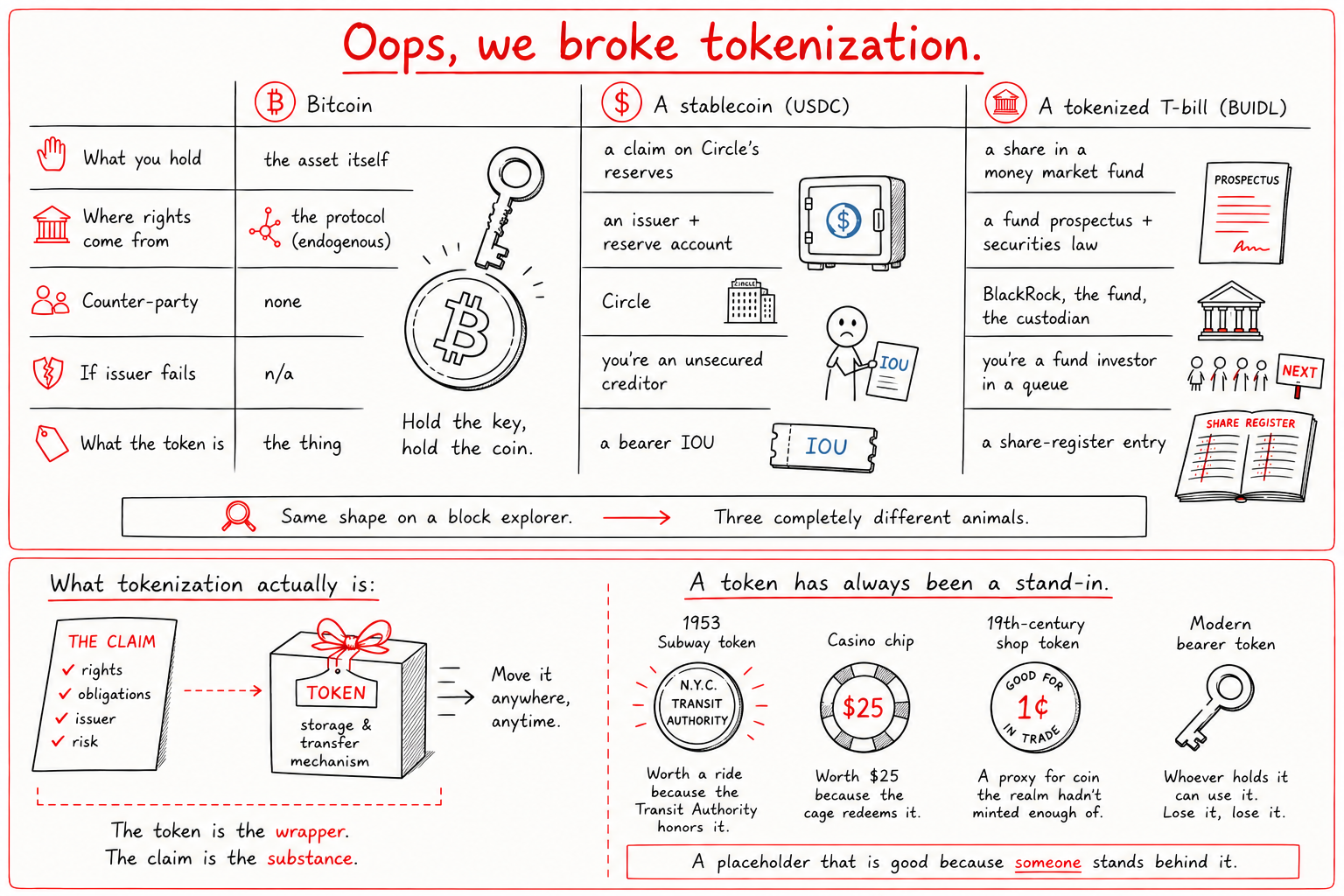
Tokenization is having its moment. There are hundreds of billions of dollars of money market funds, treasuries, private credit and dollars tokenized on public ledgers as I write this, and every bank deck has a slide about it. At Notabene we watch trillions of dollars in tokenized value flow across the network every …

Simple Convention for Human Readable Terms for Smart Contracts

Published

In the Ethereum world “Smart Contracts” refer to code. On its own a Smart Contract doesn’t necessarily create a legally binding contract. A Contract is neither code, nor a PDF file nor a printed signed document. A legally enforceable contract describes a (1) relationship between 2 or more parties (2) …

Crisis based forking can pierce the Decentralized Veil of Ethereum

Published

A large vulnerability has been found in The DAO and someone is at the time of writing funneling all it’s Ether out. A proposal has been made for the various Ethereum implementations to: Create a Soft Fork to freeze funds in any DAO sharing the same code as The DAO. This would stop funds being released while giving the …

Decision making in DAOs through voting or buying

Published

Direct voting does not work well outside small groups that know each other. Think New England town meetings, a group of business partners. The traditional way to get around this in a large group is through representative democracy. Once in a while we vote in a small group of people that can vote between themselves. …

Balance Sheets and Blockchains

Published

Balance sheets are useful terms from accounting showing a snapshot of the financial state of a company. Balance sheets consists generally of 3 columns: Assets Liabilities Equity These map directly to the Rights and Obligations I rambled on about a couple of weeks ago. An Asset is a Right and a Liability is an …

Counter-Party risk on block chains

Published

In my previous article I talked about Rights and Obligations and how they apply to blockchains. If you have the right to someone’s obligation there may be a risk that the other party can’t (or won’t) comply. This is called Counter-Party risk. A simple example of counter-party risk is if you lend money to your nephew …